
Heatmaps and tabs
How the heatmap changes depending on the metric you look at and what each tab shows.
The heatmap shows, on your own creative, the zones that capture the gaze: warm areas (red and yellow) concentrate attention; cool ones (green and blue) go almost unnoticed. It is the most direct way to answer will people look at what matters to me?
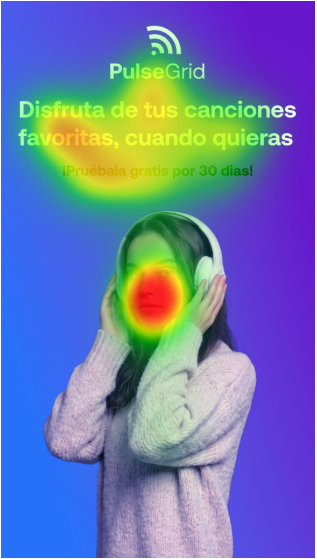 The attention map over a real creative: the face draws the gaze (red), and the headline captures secondary attention (green).
The map changes with the tab you choose
In the results there is a row of tabs, and each one changes the heatmap drawn over the creative and shows its own written read plus the "Compared to the industry" panel. These are the tabs:
- Summary — a general read of the creative, with the key scores compared against the category standard.
- First glance — attention in the first two seconds, where the initial hook is decided.
- Final impression — attention in the last two seconds, where the brand or the close usually sits.
- Attention distribution — the overall attention map of the creative.
- Engagement — where the emotional response concentrates.
- Visual complexity — how loaded with information the creative is.
- Memorability — the zones with the most potential to be remembered.
Switching tabs is the best way to read the analysis: you do not settle for a single number, you see on the image itself what is working and what is not.
Why the first seconds matter
Attention is decided very fast. In the first instants the gaze moves on impulse, before the creative is consciously processed. That is why "First glance" is so valuable: if your logo or your product falls outside that initial warm zone, it will probably be lost. And comparing "First glance" with "Final impression" tells you whether the creative hooks at the start and sustains attention through to the final message.
Beyond the big picture
The heatmap shows you where people look overall. When you want the exact number for each element — how much attention the logo, the product, or the call to action captures — use the areas of interest.