
Virality (Spread prediction)
Spread index, hook, and retention: the video's organic potential.
The Virality section, which appears in the analysis as "Spread prediction", estimates a creative's potential to spread organically, based on its own measured metrics. It does not measure likes: it measures how strong the initial hook is and how much attention the creative sustains through to the end. It is made up of three numbers, each one from 0 to 100.
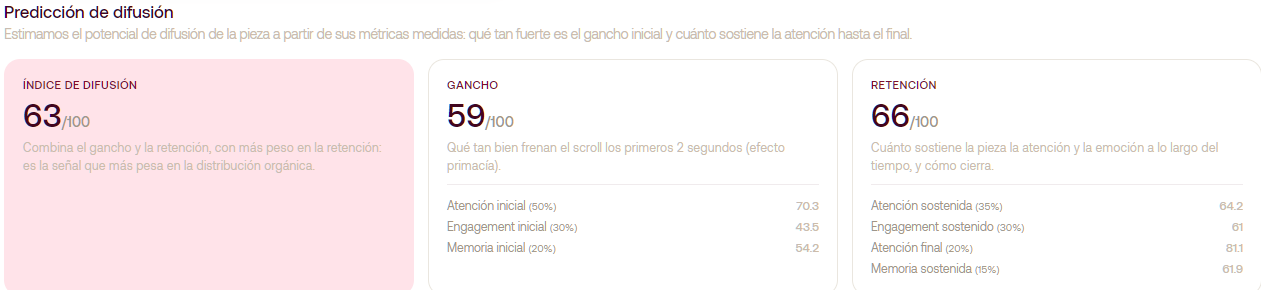 The three numbers of the spread prediction, with the submetrics that make up the hook and the retention.
Hook
Measures how well the creative stops the scroll in the first two seconds (the primacy effect). It is what decides whether someone stays to watch or keeps scrolling. It is built by combining the creative's initial metrics:
- Initial attention (highest weight)
- Initial engagement
- Initial memory
Retention
Measures how much the creative sustains attention and emotion over time, and how it closes. It combines:
- Sustained attention
- Sustained engagement
- Final attention
- Sustained memory
Spread index
This is the number that summarizes organic potential: it combines hook and retention, weighted more toward retention, because that is the signal that counts most in organic distribution. A creative can have a strong hook but, if it does not sustain attention, it spreads less than one that hooks well and retains better.
How to use it
A low hook tells you the opening needs work: the first two seconds are not stopping the scroll. A low retention indicates the creative loses the audience along the way or does not close well. The analysis pairs these numbers with a written read that interprets your video's pattern and suggests where to adjust.
One clarification
The spread prediction is an estimate based on the creative's metrics, not a guarantee of views. Real spread also depends on distribution, timing, and audience. It is useful for comparing creatives and spotting where potential is lost before publishing.